Monday, December 9, 2019
Metamorphos Man "scenario"
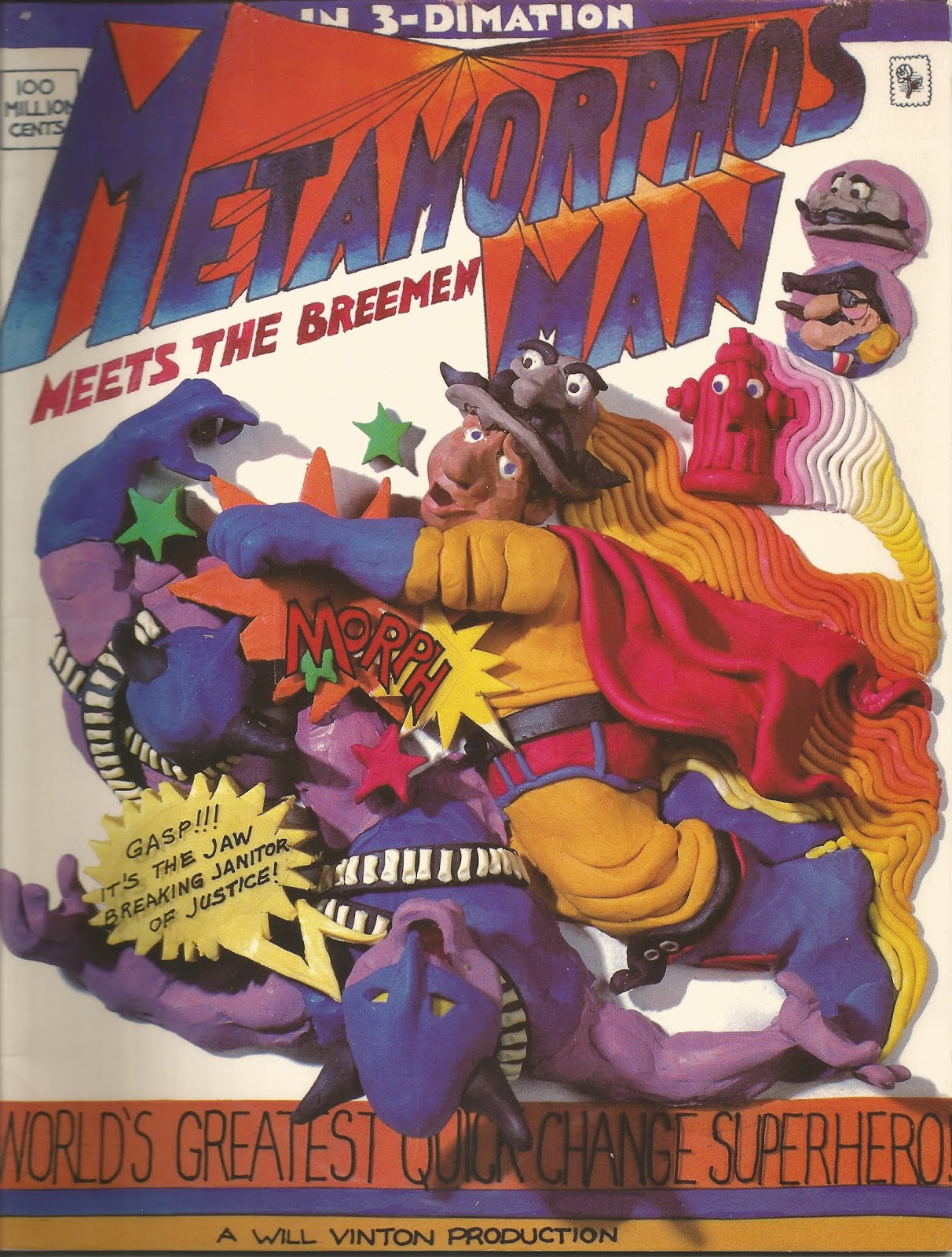
These are the front and back covers and first page of a screenplay "scenario" for the planned Claymation feature film, Metamorphos Man. Will Vinton and his wife, the late Susan Shadburne, wrote the script; Joan Gratz sculpted the cover images; Matt Wuerker did the cover heads and subheads and inside illustrations; and I handled production (editing, layout, printing, binding) and distribution.
Sunday, December 8, 2019
Michael Phillips, Will Vinton, and me
The stereotype of the arrogant, self-absorbed Hollywood producer is well deserved, if my experience with Michael Phillips is any indication. Phillips and his wife Julia produced The Sting, Taxi Driver, and Close Encounters of the Third Kind, along with several other hit movies (and a few duds). I met him at his home in Hollywood during a weeklong trip Will Vinton and I took to Los Angeles to meet with potential investors for our planned Claymation feature film, Metamorphos Man. Phillips was one of several people I had contacted and managed to arrange meetings with during our visit.
Our conversation with Phillips was short. Will gave Phillips his nutshell speech about our plans for Metamorphos Man and our need for financial aid, and then paused to ask Phillips if he had any thoughts or questions. Phillips's reply: "I'm just interested in the state of the art. I'd seen some Claymation stuff and was just curious about it."
I looked at Will, wondering how he would respond to this apparent slight. His jaw didn't quite drop, but his mouth hung open for what seemed like an eternity before he was able to reply. "Well, I'm sorry if we've wasted your time, Mr. Phillips. We'll be on our way."
Phillips didn't even make an effort to smooth things over. He stood up, shook Will's hand, shook my hand, and said blankly, "Thanks for stopping by."
Will looked more dejected than I had ever seen him, but he still managed to keep his chin up. "Well, on to the next one, eh?" he said cheerfully, looking away from me.
I haven't been to a Michael Phillips film since.
Our conversation with Phillips was short. Will gave Phillips his nutshell speech about our plans for Metamorphos Man and our need for financial aid, and then paused to ask Phillips if he had any thoughts or questions. Phillips's reply: "I'm just interested in the state of the art. I'd seen some Claymation stuff and was just curious about it."
I looked at Will, wondering how he would respond to this apparent slight. His jaw didn't quite drop, but his mouth hung open for what seemed like an eternity before he was able to reply. "Well, I'm sorry if we've wasted your time, Mr. Phillips. We'll be on our way."
Phillips didn't even make an effort to smooth things over. He stood up, shook Will's hand, shook my hand, and said blankly, "Thanks for stopping by."
Will looked more dejected than I had ever seen him, but he still managed to keep his chin up. "Well, on to the next one, eh?" he said cheerfully, looking away from me.
I haven't been to a Michael Phillips film since.
Friday, December 6, 2019
My 1974 interview with Joan Baez
In the fall of 1974 I was a second-year staff writer for the Lewis and Clark College student newspaper, The Pioneer Log, and I was cocky enough to think that I could interview just about anybody. In early November, I bought myself a ticket to see the legendary folksinger Joan Baez perform at Portland's Memorial Coliseum. My intention was partly to see the person whose hit song, "Diamonds and Rust," was giving me chills every time I heard it on the radio, and partly to see if I could score an impromptu interview with Baez after the concert.
The ticket cost me a whopping $3.50—an insanely low price even for that era (most concerts ran between $6 and $10 at the time). I remember making a mental note to myself that if I somehow got the chance to interview Baez, I would not ask her why her tickets were so cheap.
The show was amazing. I felt like I had finally seen and heard, first-hand, what all the fuss was about. Baez was, indeed, an incredibly talented singer/songwriter, and, it seemed, a really cool person. I'm pretty sure she was looking right at me when she sang "Diamonds and Rust."
Afterward, I went outside the Coliseum and found the backstage entrance, where it was rumored Baez would eventually appear. A limousine was parked near the entrance, so I figured the rumor must be true. One other guy was waiting there, a 30-something, baked-looking dude who claimed to have served as a roadie for Led Zeppelin, Jethro Tull, and Yes, among others. I think he was planning to ask Baez if she needed a roadie—never mind that she was a solo singer who played an acoustic guitar.
Finally, Joan Baez appeared, carrying her guitar case. She was accompanied by a big man in a dark suit, a manager/bodyguard/limo driver, perhaps. My heart leapt to my throat. My stomach did flip flops. What in hell was I going to say to her? I literally had not prepared for this—no questions on 3 x 5 cards, no memorized script...nothing.
"Ms. Baez," I heard my mouth blurt out.
"Yes?" Baez answered, stopping for a moment on her way to the waiting limo.
Gulp. What now?
"Um, uh...I was wondering why your tickets were only $3.50," my mouth stammered.
"As opposed to what?" Baez replied.
"Um, you know...uh, $6 or something?"
"I just wanted everyone to be able to afford to come to the concert," she replied, with astonishing grace and forbearance.
"Well, thank you!" my mouth said, no doubt looking as stupid as it sounded.
Baez smiled and climbed into her limo, leaving me wondering if I should give up on my writing career and become a roadie.
The ticket cost me a whopping $3.50—an insanely low price even for that era (most concerts ran between $6 and $10 at the time). I remember making a mental note to myself that if I somehow got the chance to interview Baez, I would not ask her why her tickets were so cheap.
The show was amazing. I felt like I had finally seen and heard, first-hand, what all the fuss was about. Baez was, indeed, an incredibly talented singer/songwriter, and, it seemed, a really cool person. I'm pretty sure she was looking right at me when she sang "Diamonds and Rust."
Afterward, I went outside the Coliseum and found the backstage entrance, where it was rumored Baez would eventually appear. A limousine was parked near the entrance, so I figured the rumor must be true. One other guy was waiting there, a 30-something, baked-looking dude who claimed to have served as a roadie for Led Zeppelin, Jethro Tull, and Yes, among others. I think he was planning to ask Baez if she needed a roadie—never mind that she was a solo singer who played an acoustic guitar.
Finally, Joan Baez appeared, carrying her guitar case. She was accompanied by a big man in a dark suit, a manager/bodyguard/limo driver, perhaps. My heart leapt to my throat. My stomach did flip flops. What in hell was I going to say to her? I literally had not prepared for this—no questions on 3 x 5 cards, no memorized script...nothing.
"Ms. Baez," I heard my mouth blurt out.
"Yes?" Baez answered, stopping for a moment on her way to the waiting limo.
Gulp. What now?
"Um, uh...I was wondering why your tickets were only $3.50," my mouth stammered.
"As opposed to what?" Baez replied.
"Um, you know...uh, $6 or something?"
"I just wanted everyone to be able to afford to come to the concert," she replied, with astonishing grace and forbearance.
"Well, thank you!" my mouth said, no doubt looking as stupid as it sounded.
Baez smiled and climbed into her limo, leaving me wondering if I should give up on my writing career and become a roadie.
Wednesday, December 4, 2019
My logo for the OSU Daily Barometer's "After Hours" supplement
I've designed a few logos in my time, but none quite as fun as this one. It was really a long-shot submission to a logo competition for the OSU student newspaper's (Daily Barometer) "After Hours" supplement. By some bizarre twist of fate—my logo was, after all, up against those of far more experienced and talented artists, including OSU graphic design students—I won the competition, along with three quarts of Pennzoil. Here's the January 21, 1992, Barometer article about my astonishing victory.
Tuesday, December 3, 2019
Andy Borowitz and me
Between about 2004 and 2008, I had a political blog called Editor at Large. Among several celebrity connections I made through the blog was humorist Andy Borowitz, who at that time had a daily column called "The Borowitz Report," to which I subscribed via e-mail. A couple of times I spotted typos in his report and alerted him to them. Borowitz graciously responded, "You should be working here!"
Some time later, Borowitz used the word "miniscule," which I informed him should be spelled "minuscule." His reply: "With all due respect, it's acceptable to spell 'minuscule' either way."
Borowitz was correct, as it turned out, and I was mortified. I suspected that Andy Borowitz would never again engage with me in even the most miniscule way.
Now, of course, Borowitz is famous for his column in The New Yorker, which is not only funny as hell, but so far contains very few typos.
Some time later, Borowitz used the word "miniscule," which I informed him should be spelled "minuscule." His reply: "With all due respect, it's acceptable to spell 'minuscule' either way."
Borowitz was correct, as it turned out, and I was mortified. I suspected that Andy Borowitz would never again engage with me in even the most miniscule way.
Now, of course, Borowitz is famous for his column in The New Yorker, which is not only funny as hell, but so far contains very few typos.
Eddie Vedder, Sean McKean, and us
Jules and I first met the dreadlocked and highly personable Sean McKean through our noontime Faculty-Staff Fitness yoga classes at Oregon State University (OSU). Later, Jules and Sean became friends, and he would often come to our house for a meal or to demonstrate his latest vaping device. One time he even helped me move a huge doghouse from our shed to the backyard (thanks, Sean!). For a couple of years, Sean co-taught yoga classes—dreadlocks flying between poses—with Jules at OSU's Dixon Recreation Center.
Sean often told us he was getting tired of his dreadlocks and wished he could muster the courage to have them cut off. One day, he did just that. The barber? Eddie Vedder, lead singer for Pearl Jam. Here's a video of how it all went down, so to speak:
Sean later offered us a lock of his shorn dreads, but we foolishly turned him down. It'll probably be worth thousands someday on Antiques Roadshow!
Sean often told us he was getting tired of his dreadlocks and wished he could muster the courage to have them cut off. One day, he did just that. The barber? Eddie Vedder, lead singer for Pearl Jam. Here's a video of how it all went down, so to speak:
Sean later offered us a lock of his shorn dreads, but we foolishly turned him down. It'll probably be worth thousands someday on Antiques Roadshow!
Monday, December 2, 2019
Jean Shepherd and me
You might be familiar with the 1983 movie A Christmas Story, which is about a young boy named Ralphie who tries to convince his parents, his teacher, and Santa that a Red Ryder BB gun is the perfect Christmas gift. The story is based on the semi-autobiographical writings of American humorist Jean Shepherd, who also narrated the movie.
I had never heard of Jean Shepherd before I had a brief but amusing exchange with him on the phone. It happened when I was about 14, and my neighbor Paul and I were listening to Portland's KBOO Radio, which at the time was having a pledge drive featuring Shepherd as its celebrity co-host. Shepherd was inviting listeners to phone in and chat with him, in exchange for pledging money to KBOO. At one point, Shepherd mentioned that he was a private pilot, and my ears perked up. My dad was also a private pilot who, with four friends, co-owned and flew a 1947 Funk airplane.
I decided to call, against all odds of getting through due to the undoubtedly high volume of calls. I seriously was not expecting to actually get to speak with the famous Jean Shepherd, whoever he was.
Miraculously, I got through on my first try. Shit, what will I say? Before I even had a chance to come up with something, anything, I heard Shepherd's voice booming through the receiver.
Shepherd: Hello, KBOO; Jean Shepherd here. What would you like to talk about?
Me: Um...uh...um...I...I understand you're a pilot.
Shepherd: Yes, I am.
Me: My dad's a pilot, too. He flies a 1947 Funk.
Shepherd: I once dated a funk!
I laughed, Shepherd laughed, he thanked me for calling, and that was it. Years later, when I saw A Christmas Story and realized whom I had spoken with, I felt both proud and embarrassed: Proud that I had actually spoken on the phone with Shepherd, but embarrassed by my inane choice of topics. Kudos to Shepherd, though, for not only managing to avoid shaming me, but for making me feel like I was his sidekick, setting him up for a joke.
And that's my little "Christmas Story."
I had never heard of Jean Shepherd before I had a brief but amusing exchange with him on the phone. It happened when I was about 14, and my neighbor Paul and I were listening to Portland's KBOO Radio, which at the time was having a pledge drive featuring Shepherd as its celebrity co-host. Shepherd was inviting listeners to phone in and chat with him, in exchange for pledging money to KBOO. At one point, Shepherd mentioned that he was a private pilot, and my ears perked up. My dad was also a private pilot who, with four friends, co-owned and flew a 1947 Funk airplane.
I decided to call, against all odds of getting through due to the undoubtedly high volume of calls. I seriously was not expecting to actually get to speak with the famous Jean Shepherd, whoever he was.
Miraculously, I got through on my first try. Shit, what will I say? Before I even had a chance to come up with something, anything, I heard Shepherd's voice booming through the receiver.
Shepherd: Hello, KBOO; Jean Shepherd here. What would you like to talk about?
Me: Um...uh...um...I...I understand you're a pilot.
Shepherd: Yes, I am.
Me: My dad's a pilot, too. He flies a 1947 Funk.
Shepherd: I once dated a funk!
I laughed, Shepherd laughed, he thanked me for calling, and that was it. Years later, when I saw A Christmas Story and realized whom I had spoken with, I felt both proud and embarrassed: Proud that I had actually spoken on the phone with Shepherd, but embarrassed by my inane choice of topics. Kudos to Shepherd, though, for not only managing to avoid shaming me, but for making me feel like I was his sidekick, setting him up for a joke.
And that's my little "Christmas Story."
Subscribe to:
Posts (Atom)


